> For the complete documentation index, see [llms.txt](https://docs.nimbalyst.com/llms.txt). Markdown versions of documentation pages are available by appending `.md` to page URLs; this page is available as [Markdown](https://docs.nimbalyst.com/file-management/multi-folder-projects.md).
# Multi-Folder Projects
Attach additional folders to a project so one workspace spans several repositories. Attached folders appear in the explorer, in search, and to your agents, with git tracked per repository.
A project can span several folders. When your work lives across a few repositories but belongs to one effort, attach the other folders to the project you already have open instead of juggling separate windows.
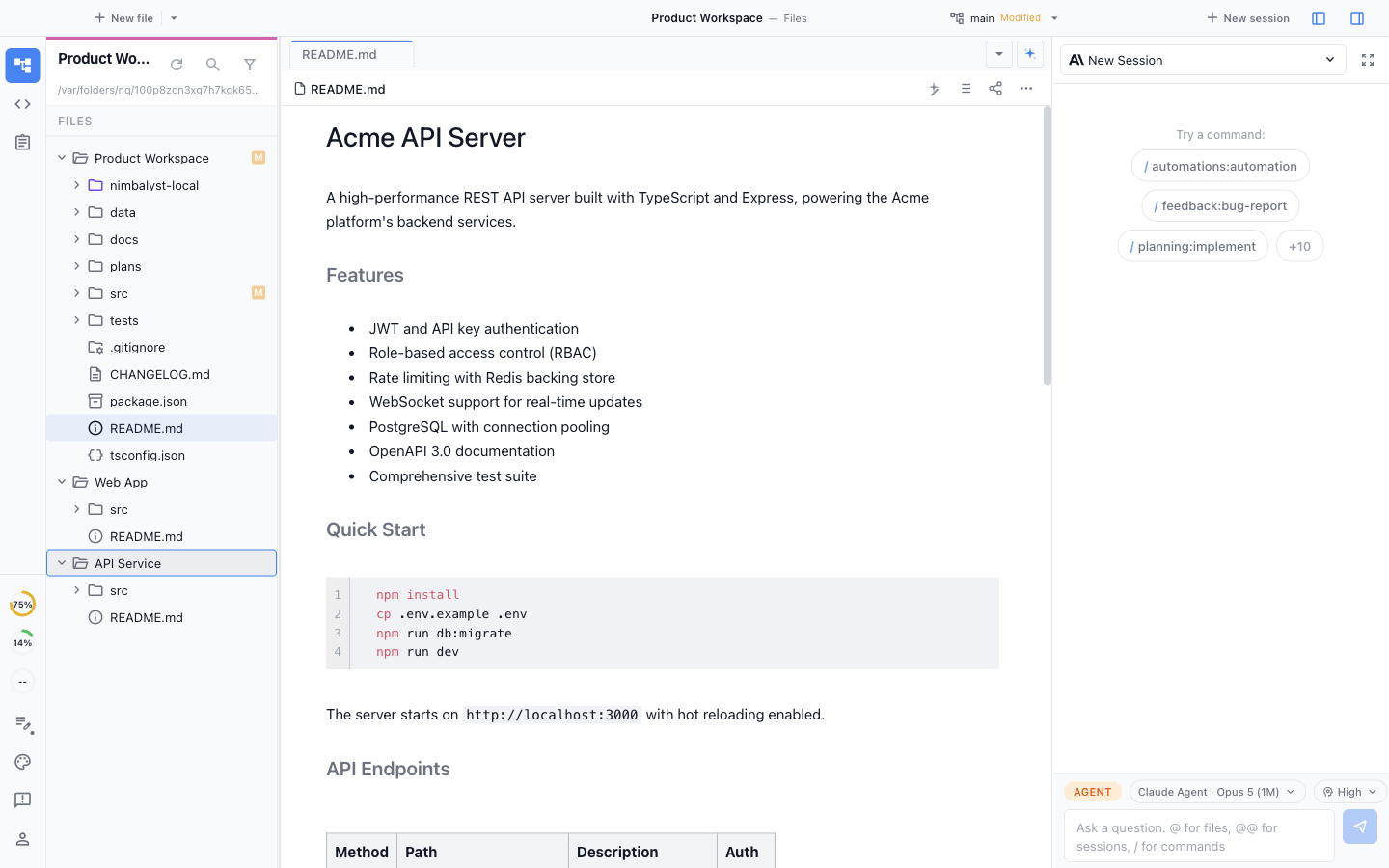
Each attached folder appears as its own root in the same file explorer.
An attached folder becomes part of the workspace:
* It appears in the file tree as its own root, alongside the primary folder
* Quick Open and in-file search cover it
* Your agents can read and write it, in every session in the project
* Git status, branches, and commits are tracked per repository, so each root shows its own branch and changes. Commit with AI proposes one commit per repository when changes span several. See [Working with Git](/developer-features/working-with-git.md)
## Attaching a Folder
Attach a folder any of these ways:
* **File menu**: choose **Attach Folder to Workspace** and pick the folder
* **Quick Open**: search for the folder and attach it from there
* **Explorer**: right-click in the file tree and attach from the context menu
* **Drag and drop**: drop a folder from Finder or File Explorer onto the file tree
Whichever way you start, Nimbalyst confirms before attaching. The attached folder becomes part of this project and inherits its agent trust level, which means agents in the project will be able to read and write it. If that folder deserves different trust than the project it is joining, keep it as its own project instead.
A workspace holds up to eight attached folders in addition to the primary one.
## Detaching a Folder
Right-click the attached root in the file tree to detach it. Detaching removes the root from the project but touches nothing on disk, and any tabs you had open from it stay open.
## How It Relates to Projects
The primary folder still defines the project: its name, its settings, and the trust level everything runs under. Attached folders ride along. If you open one of the attached folders as its own project later, it behaves like any other project, with no memory of having been attached elsewhere.
---
# Agent Instructions
This documentation is published with GitBook. GitBook is the documentation platform designed so that both humans and AI agents can read, navigate, and reason over technical content effectively. Learn more at gitbook.com.
## Querying This Documentation
If you need additional information that is not directly available in this page, you can query the documentation dynamically by asking a question.
Perform an HTTP GET request on the current page URL with the `ask` query parameter, and the optional `goal` query parameter:
```
GET https://docs.nimbalyst.com/file-management/multi-folder-projects.md?ask=&goal=
```
`ask` is the immediate question: it should be specific, self-contained, and written in natural language.
`goal` is optional and describes the broader end goal you are ultimately trying to accomplish on behalf of the user. GitBook uses it to tailor the answer towards what is most useful for that goal.
The response will contain a direct answer to the question and relevant excerpts and sources from the documentation.
Use this mechanism when the answer is not explicitly present in the current page, you need clarification or additional context, or you want to retrieve related documentation sections.