> For the complete documentation index, see [llms.txt](https://docs.nimbalyst.com/llms.txt). Markdown versions of documentation pages are available by appending `.md` to page URLs; this page is available as [Markdown](https://docs.nimbalyst.com/task-management/creating-items.md).

# Creating Items

Several ways to create tracker items in Nimbalyst, from asking your AI agent during a session to writing inline tags or YAML in markdown.

You can create a tracker item wherever the work first appears: in a chat with the agent, inline in a document you are writing, or straight from the tracker panel. This page walks through each path, from conversational AI to structured YAML.

### From Chat

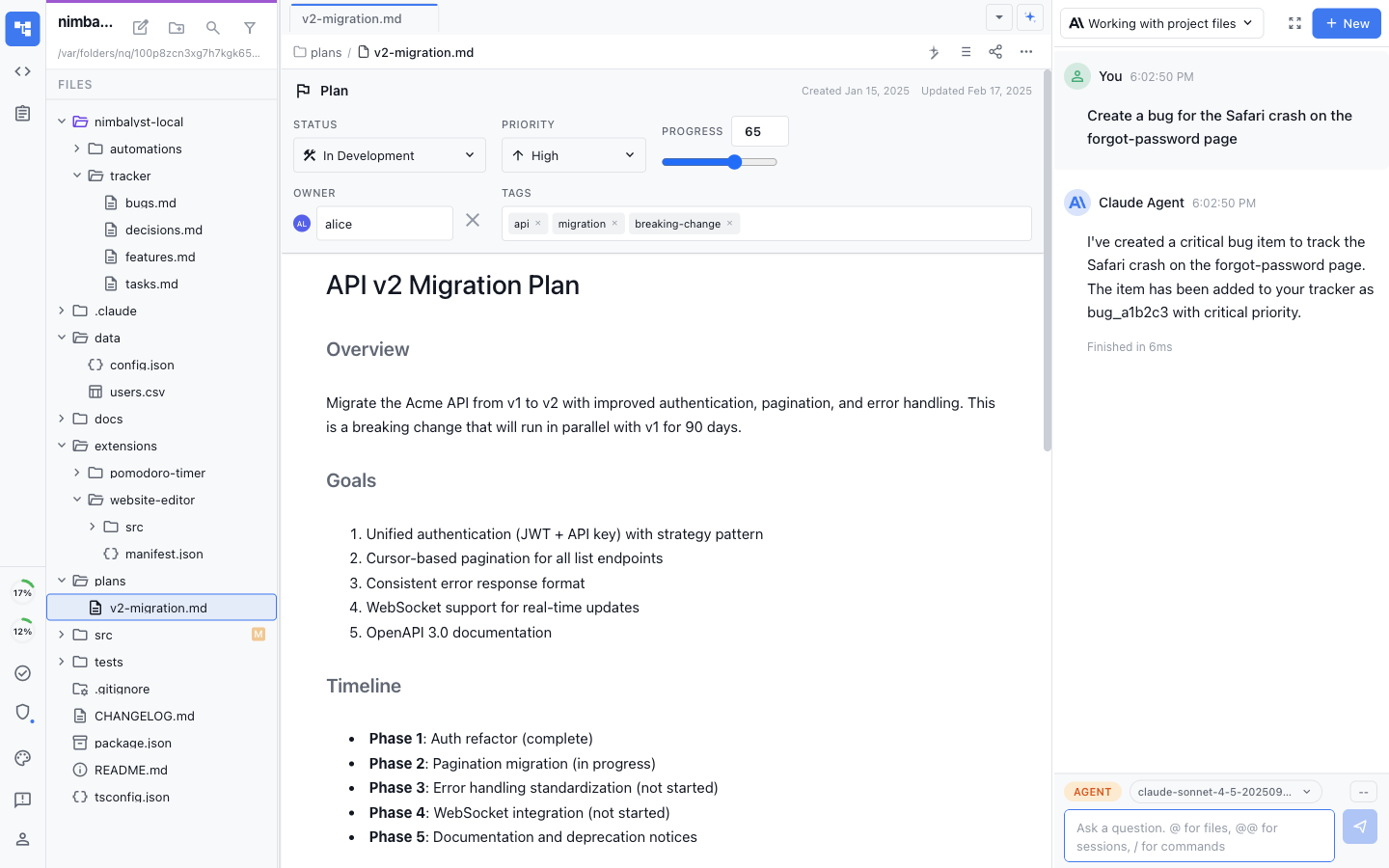
Ask the AI agent to create items during any session:

> "Create a bug for the login page crash on Safari" "Track this as a feature request: dark mode for the dashboard" "Log a decision: we're using PostgreSQL instead of MongoDB"

The AI determines the appropriate type, sets the status and fields based on your description, and creates the item. Ask the agent to link the item to the current session when that relationship should be recorded.

Turning a conversation into tracked work is one of the workflows in [project planning](https://nimbalyst.com/use-cases/project-planning/).

<figure><img src="https://562749618-files.gitbook.io/~/files/v0/b/gitbook-x-prod.appspot.com/o/spaces%2FiVUeHZHlFlZrZt02syRC%2Fuploads%2Fgit-blob-60961e5f4be762b3e1af1b3e7196c83362ab1b80%2Ffeature-tracker-create-chat.png?alt=media" alt="A chat panel where the user asks for a bug to be created for a Safari crash and the agent confirms it created a critical bug item, next to an open plan document"><figcaption><p>Ask the agent in chat to create an item. Here it files a critical bug for the Safari crash while a plan document stays open in the editor.</p></figcaption></figure>

### From the /track Command

Use `/track` in the chat input for quick inline creation:

```
/track Login page crashes on Safari when clicking forgot password
```

The AI analyzes your description, determines the item type (bug, task, feature, etc.), and creates the item. This is the fastest path when you know what you want to track.

### Inline in Markdown

Track items directly within any markdown document using `#type[...]` syntax:

```markdown
## Sprint Items

- Fix Safari crash #bug[status:to-do priority:critical]
- Add dark mode toggle #feature[status:in-progress priority:high owner:karl]
- Consider Redis for caching #idea[status:new]
- Use WebSockets over polling #decision[status:decided]
- Migrate to PostgreSQL #task[status:to-do priority:medium]
```

<figure><img src="https://562749618-files.gitbook.io/~/files/v0/b/gitbook-x-prod.appspot.com/o/spaces%2FiVUeHZHlFlZrZt02syRC%2Fuploads%2Fgit-blob-16fce2e510620d60d255c474b35786e601f24eb2%2Ffeature-tracker-inline-tags.png?alt=media" alt="A markdown plan document with a Next Steps checklist whose lines carry inline #task and #idea tags rendered as chips with priority and status icons"><figcaption><p>Inline tags render as live chips in the document. Each checklist line here is also a tracked task or idea.</p></figcaption></figure>

Inline items appear in the tracker alongside full-document items. Edit their properties in the markdown text or through the tracker UI; changes sync both ways.

### From YAML Frontmatter

Add `trackerStatus` frontmatter to any markdown file to make it a tracked item:

```yaml
---
trackerStatus:
  type: plan
title: Database Migration Strategy
status: draft
priority: high
owner: karl@example.com
tags: [backend, database]
---

## Overview

This plan covers migrating from SQLite to PostgreSQL...
```

The tracker system automatically picks up files with `trackerStatus` frontmatter and displays them in the kanban board. Changes to the file update the tracker item, and changes made through the tracker UI update the file.

This approach works well for plans, decisions, and features that deserve their own dedicated document.

For plans and decisions you don't have to write that block by hand. Open the three-dot Actions menu on any markdown document and use [Set Document Type](/visual-editors-powered-by-ai/markdown-wysiwyg/set-document-type.md) to have Nimbalyst write the frontmatter for you.

### Quick Track from Anywhere

Press **Cmd+Shift+I** anywhere in the app to file a tracker item of any type without leaving what you are doing. Pick the type, give it a title, and it lands in your tracker. Before you add it, Quick Track offers similar existing items, so you can jump to one instead of creating a duplicate.

### From the Tracker Panel

You can also click the **+New** button in the tracker panel to create an item directly. Select the type, fill in the fields, and the item is added to your tracker.


---

# Agent Instructions
This documentation is published with GitBook. GitBook is the documentation platform designed so that both humans and AI agents can read, navigate, and reason over technical content effectively. Learn more at gitbook.com.

## Querying This Documentation
If you need additional information that is not directly available in this page, you can query the documentation dynamically by asking a question.

Perform an HTTP GET request on the current page URL with the `ask` query parameter, and the optional `goal` query parameter:

```
GET https://docs.nimbalyst.com/task-management/creating-items.md?ask=<question>&goal=<endgoal>
```

`ask` is the immediate question: it should be specific, self-contained, and written in natural language.
`goal` is optional and describes the broader end goal you are ultimately trying to accomplish on behalf of the user. GitBook uses it to tailor the answer towards what is most useful for that goal.

The response will contain a direct answer to the question and relevant excerpts and sources from the documentation.

Use this mechanism when the answer is not explicitly present in the current page, you need clarification or additional context, or you want to retrieve related documentation sections.
