> For the complete documentation index, see [llms.txt](https://docs.nimbalyst.com/llms.txt). Markdown versions of documentation pages are available by appending `.md` to page URLs; this page is available as [Markdown](https://docs.nimbalyst.com/task-management/item-detail.md).

# Item Detail, Comments, Activity

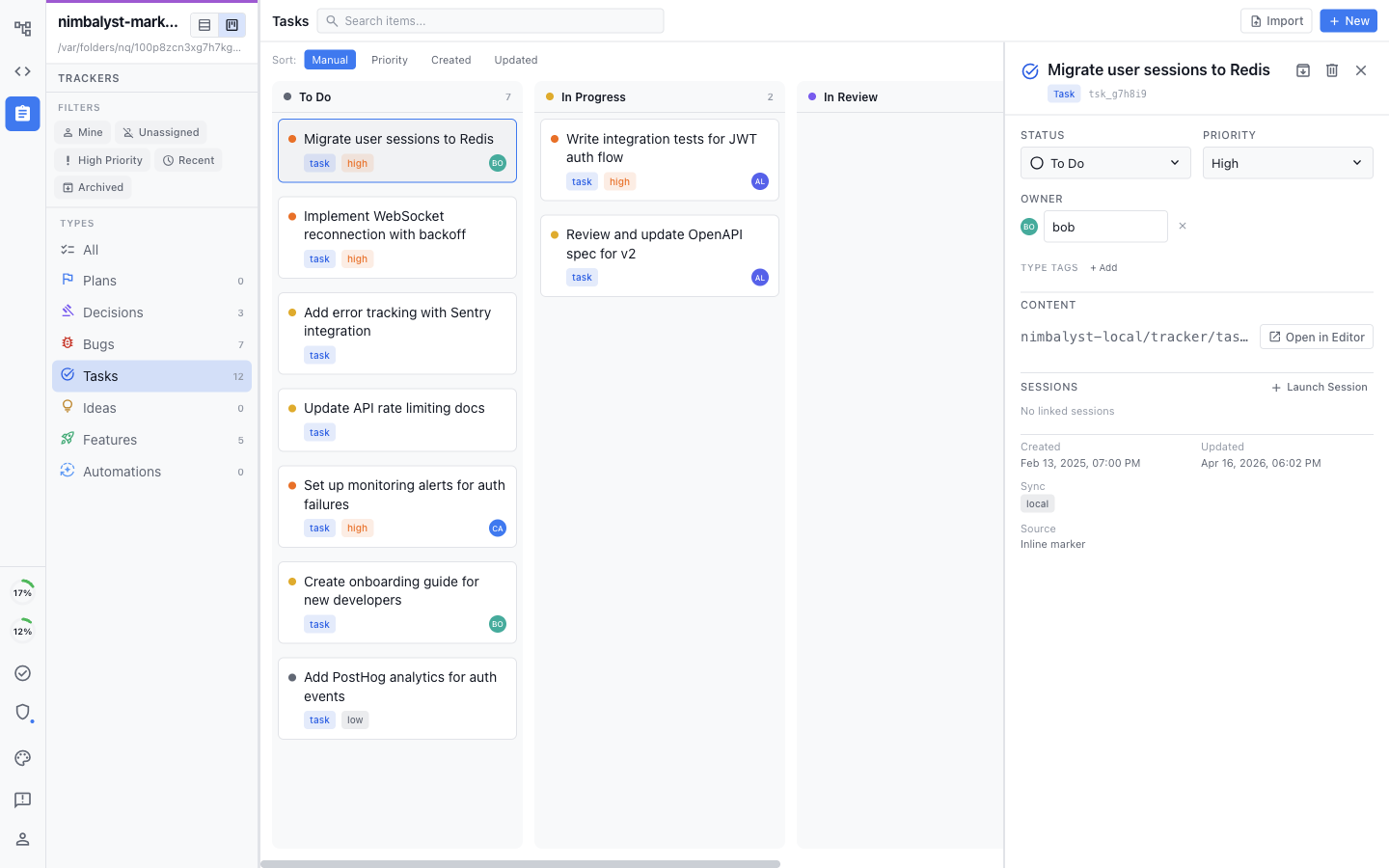
Click any item in the kanban board or list view to open the detail panel. The detail view shows all fields for an item and lets you edit them in place.

<figure><img src="/files/tAfeD87bVRVV1tFj83VP" alt=""><figcaption></figcaption></figure>

### Editable Fields

* **Title** -- Click the title text to edit it inline.
* **Status** -- Dropdown with all valid statuses for the item's type.
* **Priority** -- Dropdown (Critical, High, Medium, Low).
* **Owner** -- User picker to assign responsibility.
* **Description** -- Text area for detailed notes and context.
* **Tags** -- Add or remove categorization tags.
* **Due Date** -- Date picker for deadlines.
* **Progress** -- Percentage slider, available on Plan items only.

Fields vary by item type. For example, Feature items include Release Version and Release Notes, while Idea items have only Title and Status.

### Comments

Add comments to discuss an item without changing its fields. Each comment shows the author and timestamp.

<figure><img src="/files/tAfeD87bVRVV1tFj83VP" alt=""><figcaption></figcaption></figure>

Comments are useful for team discussions, leaving notes for your future self, or recording context that doesn't fit in the description. AI agents can also add comments to items during sessions.

You can edit or delete your own comments. Hover a comment you wrote and use the pencil to edit it inline (press Enter to save, Escape to cancel), or the trash icon to delete it. Edited comments are marked as edited.

### Activity Log

Every change to an item is recorded in the activity log:

* **Who** made the change (you or an AI agent)
* **When** it happened
* **What** changed (field name, before value, after value)

<figure><img src="/files/tAfeD87bVRVV1tFj83VP" alt=""><figcaption></figcaption></figure>

The activity log provides a complete audit trail. When an AI agent updates an item during a session -- marking a bug as done or changing a plan's progress -- that change is recorded with the same detail as manual edits.

### Linked Sessions

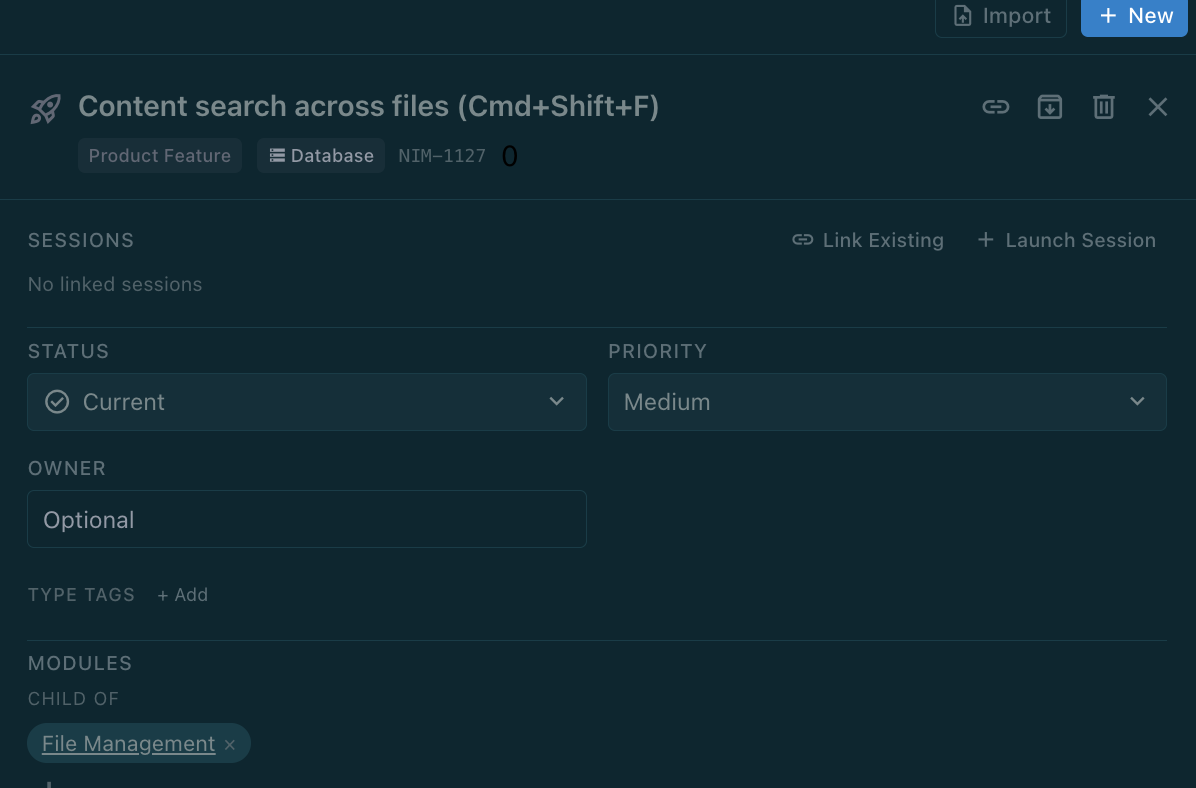
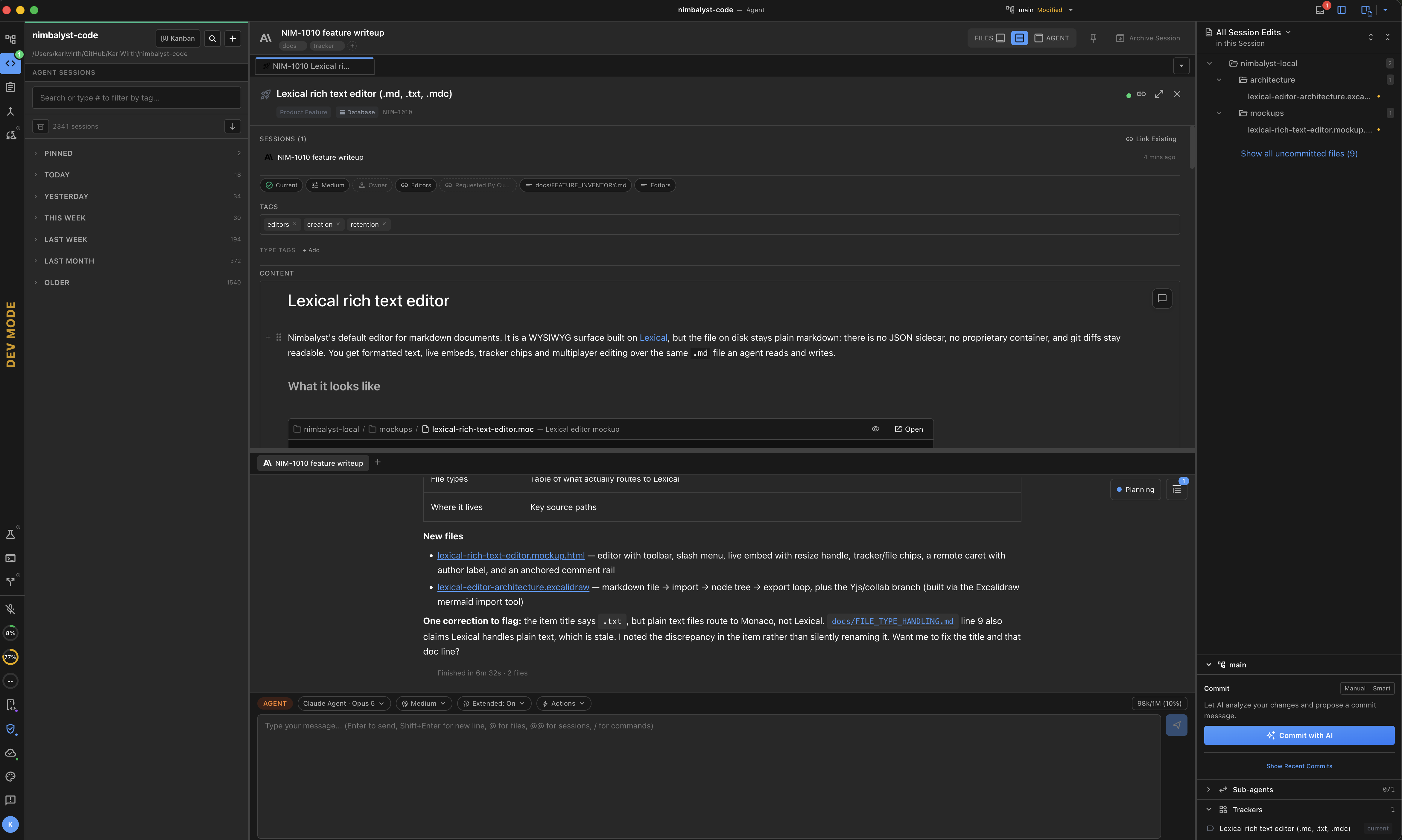
Linked sessions appear at the top of the detail panel, above the item's fields, with a count. Each one shows the provider, the session title, and when it was last active. Click one to jump back to that conversation. Use **Launch Session** to start a fresh session for the item, or **Link Existing** to connect a session you already have.

<figure><img src="/files/GQgwR62sHRzPm0Vw9mW5" alt="Tracker item detail with the Sessions section at the top, above Status and Priority"><figcaption><p>The Sessions section sits at the top of the item detail, with Link Existing and Launch Session controls.</p></figcaption></figure>

Linking is deliberate: creating or updating an item does not attach your current session unless you ask for it. See [AI Integration](/task-management/ai-integration.md) for how agents link sessions.

### Launch an Isolated Worktree

When Git worktrees are available, choose **Launch Worktree** in the Sessions section to start an isolated worktree and AI session for the item.

Nimbalyst proposes a branch and worktree name from the Tracker key and title, inserts a live Tracker reference into the session draft, and links the resulting session back to the item. Review the worktree details before creating it.

Use **Launch Session** for work that can happen in the current project checkout. Use **Launch Worktree** when the task needs its own branch and filesystem state. See [Worktrees](/developer-features/worktrees.md).

### Linked Files

Items backed by markdown files show their source file path. You can also explicitly link additional files to an item for reference -- design docs, specs, or related source code.


---

# Agent Instructions
This documentation is published with GitBook. GitBook is the documentation platform designed so that both humans and AI agents can read, navigate, and reason over technical content effectively. Learn more at gitbook.com.

## Querying This Documentation
If you need additional information that is not directly available in this page, you can query the documentation dynamically by asking a question.

Perform an HTTP GET request on the current page URL with the `ask` query parameter, and the optional `goal` query parameter:

```
GET https://docs.nimbalyst.com/task-management/item-detail.md?ask=<question>&goal=<endgoal>
```

`ask` is the immediate question: it should be specific, self-contained, and written in natural language.
`goal` is optional and describes the broader end goal you are ultimately trying to accomplish on behalf of the user. GitBook uses it to tailor the answer towards what is most useful for that goal.

The response will contain a direct answer to the question and relevant excerpts and sources from the documentation.

Use this mechanism when the answer is not explicitly present in the current page, you need clarification or additional context, or you want to retrieve related documentation sections.