> For the complete documentation index, see [llms.txt](https://docs.nimbalyst.com/llms.txt). Markdown versions of documentation pages are available by appending `.md` to page URLs; this page is available as [Markdown](https://docs.nimbalyst.com/task-management/kanban-and-list.md).

# Views: Kanban, List, and Tag Board

The tracker gives you several ways to look at your items: a kanban board for visual status management, a list view for dense sortable data, and a tag board for organizing by tag. Save any arrangement of filters and grouping as a named view to return to later.

### Kanban Board

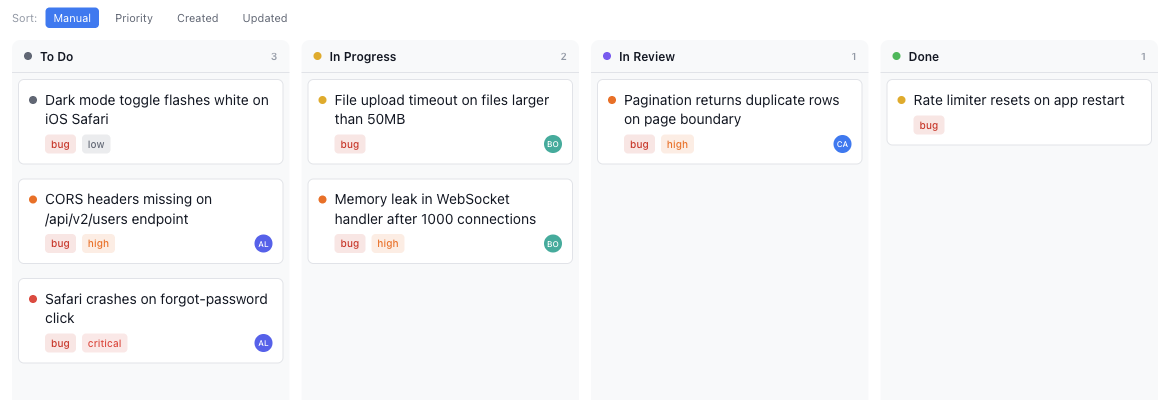
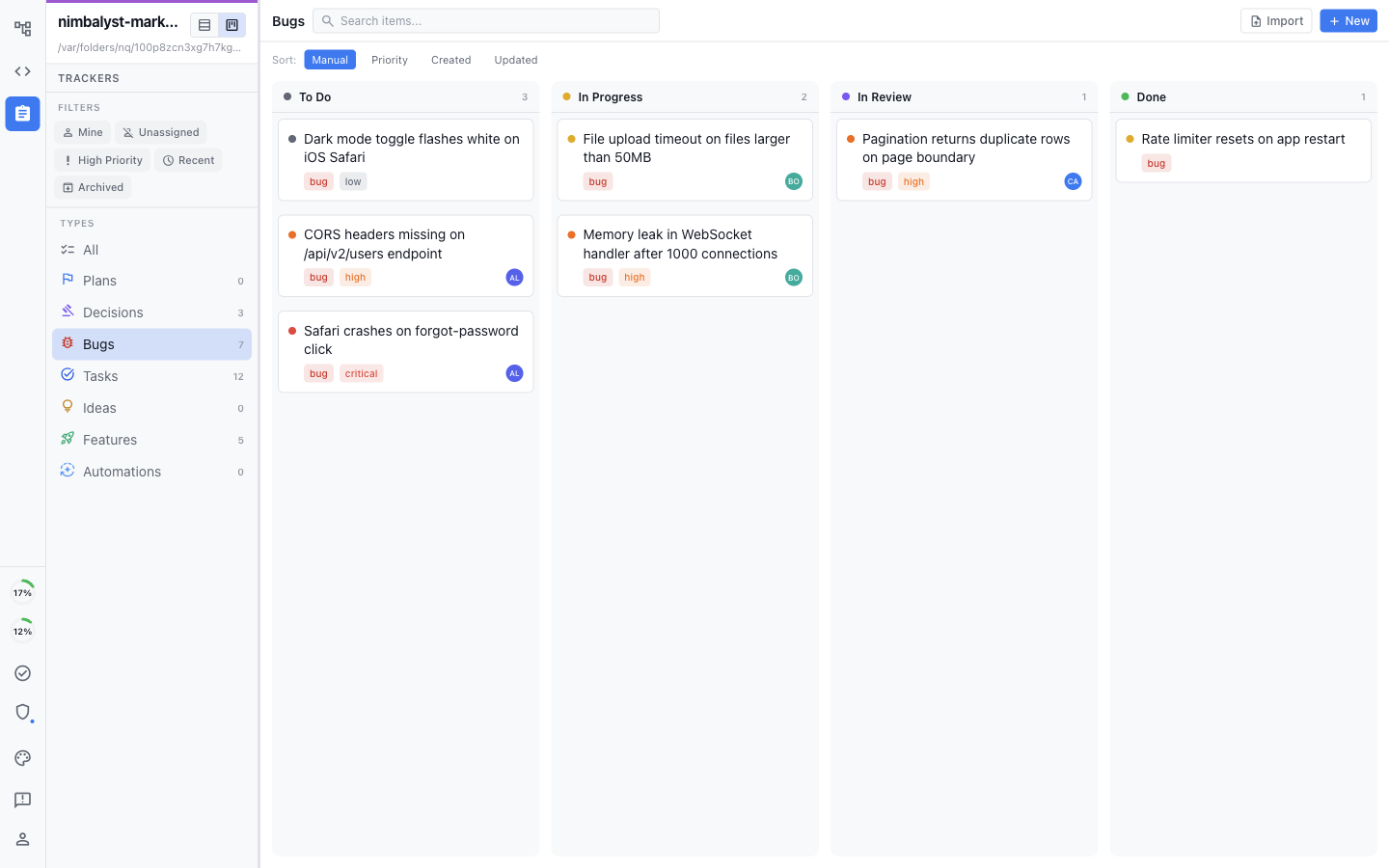
The kanban board organizes items into columns by status. Each item type has its own status workflow, so the columns change depending on which type you are viewing. For custom types, the columns follow the order of the status options you defined in the type's schema.

<figure><img src="/files/HQCuarKTb1srEJPlI3uh" alt=""><figcaption></figcaption></figure>

### Moving Items

* **Drag between columns** to change an item's status. Dragging a task from "To Do" to "In Progress" updates the item immediately.
* **Drag within a column** to reorder items. Manual ordering lets you prioritize work visually without changing status.

### Card Display

Each card on the board shows:

* Type icon (color-coded by item type)
* Item title
* Priority badge (if set)
* Owner avatar (if assigned)
* Type tag label

<figure><img src="/files/QgODlwnuHpjPjN22SCsj" alt=""><figcaption></figcaption></figure>

### Detailed View

* Click any card to open its detail view.

<figure><img src="/files/ynEPB3Qh2GEHDXUqy3gb" alt=""><figcaption></figcaption></figure>

### Selection

* **Click** a card to select it and open the detail panel.
* **Shift-click** to select a range of cards.
* **Click a column header** to select all cards in that column.
* **Right-click a column header** to open a context menu with bulk actions.

### Filtering

Filter chips and controls sit in the Tracker sidebar:

* **"Mine"** -- Show only items assigned to you.
* **"Unassigned"** -- Show only items with no owner.
* **High Priority** -- Show items with High or Critical priority.
* **Favorites** -- Show items you have starred.
* **Recently Viewed** -- Return to items you opened recently, ordered by your most recent view.
* **Edited by Others** -- Show the latest items whose most recent known editor is someone other than you.
* **Recent** -- Show the 50 most recently updated items.
* **Archived** -- Switch from active items to archived items.
* **Type filter** -- Select which item type to display (Bug, Task, Feature, etc.).
* **Text search** -- Search across titles, descriptions, and item IDs.

<figure><img src="/files/ZxpmnX4PBDWPB3jg9F6P" alt="Tracker sidebar showing Favorites, Recently Viewed, Edited by Others, Recent, and Archived filters"><figcaption><p>Combine personal filters, type folders, saved views, search, and board controls to focus on the work that matters now.</p></figcaption></figure>

Click the star on a Tracker row or card to add or remove it from Favorites. Favorites and recently viewed state belong to you; starring an item does not change it for teammates.

The three recency filters are mutually exclusive because each uses a different ordering. Other filters can be combined and saved as a named view.

### List View

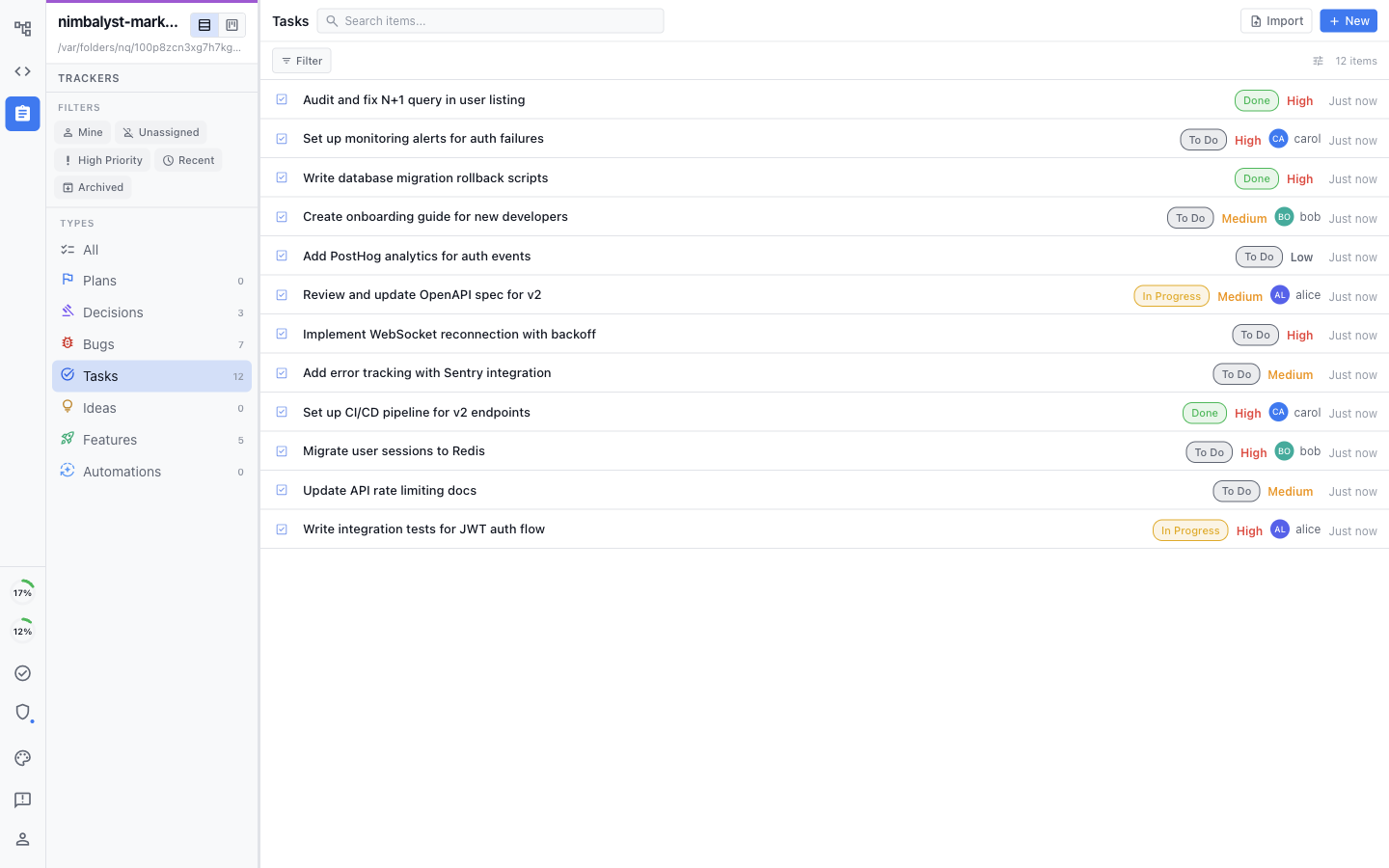
Switch to the list view for a table-based layout. The list view shows one row per item with sortable columns.

<figure><img src="/files/X8mzTF9d1UL6fn0Z8Czc" alt=""><figcaption></figcaption></figure>

* **Click a column header** to sort by that field (title, status, priority, owner, etc.).
* **Resize columns** by dragging the column border.
* **Configure visible columns** to show or hide fields that matter to you.
* Turn on the optional **Shared** column to see which items are shared with your team (off by default). See [Sharing Plans and Trackers](/task-management/sharing-plans-and-trackers.md).
* The same filtering and search controls from the kanban view apply here.

The list view works well when you have many items and need to scan or sort quickly, while the kanban view is better for visualizing workflow stages.

### Tag Board

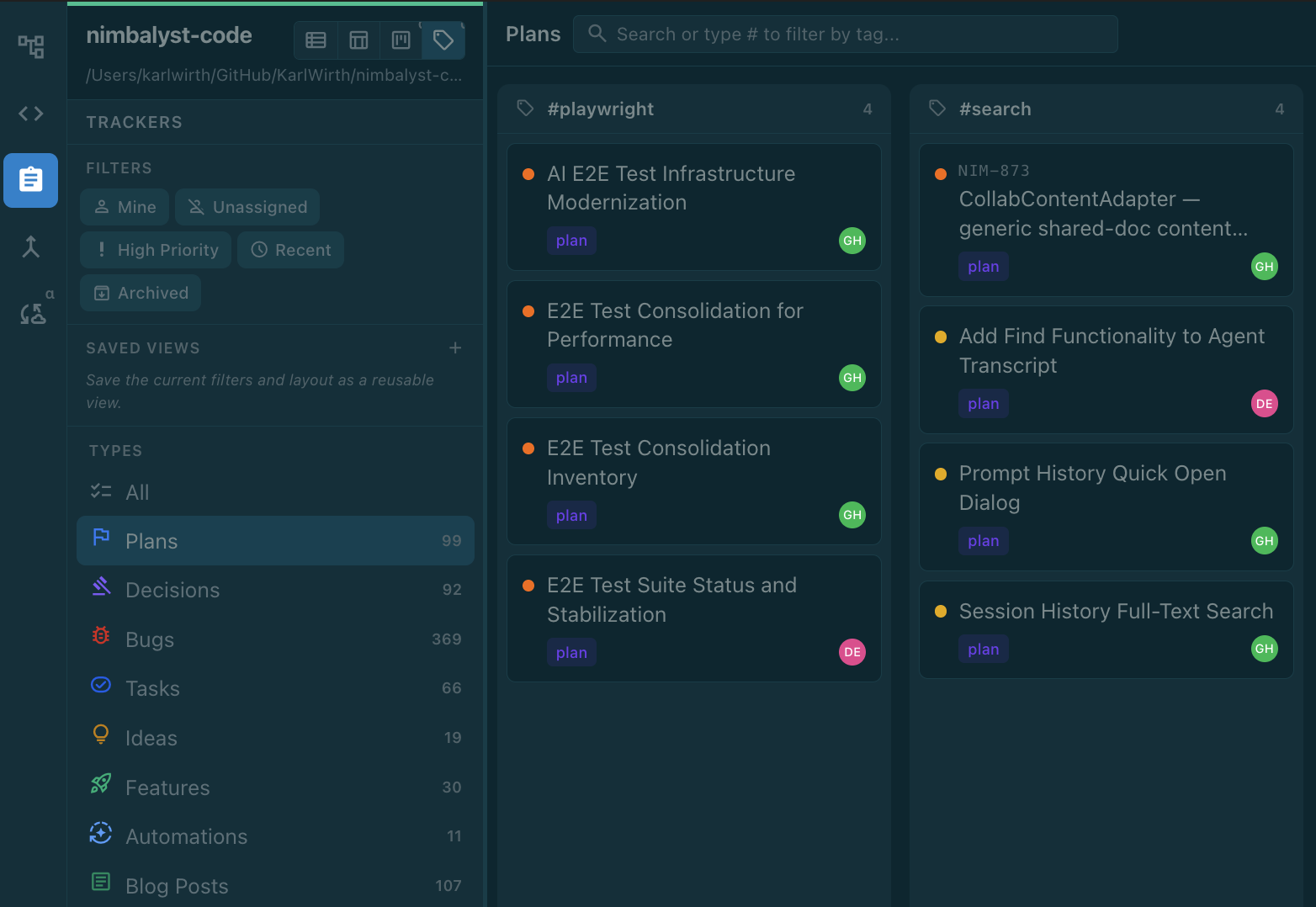
The tag board (alpha) arranges items into one column per tag, with an "Untagged" column for the rest. An item with several tags appears in each matching column, so you can see everything touching a given area at once. Switch to it from the view buttons at the top of the tracker. The tag board is for organizing and scanning; open an item to make changes.

<figure><img src="/files/RdGvte2vDCvmlIemJbIA" alt="Tracker tag board showing plans grouped into #playwright and #search columns"><figcaption><p>The tag board groups items into a column per tag. Use the search bar to filter by tag with #.</p></figcaption></figure>

### Saved Views

Any combination of type filter, filter chips, grouping, and view mode can be saved as a named view. Set the tracker up the way you want it, then in the **Saved Views** section of the sidebar click **+**, name the view, and press Enter. Saved views appear in the sidebar; click one to reapply all of its settings at once. Remove a view by hovering it and clicking the **×**.


---

# Agent Instructions
This documentation is published with GitBook. GitBook is the documentation platform designed so that both humans and AI agents can read, navigate, and reason over technical content effectively. Learn more at gitbook.com.

## Querying This Documentation
If you need additional information that is not directly available in this page, you can query the documentation dynamically by asking a question.

Perform an HTTP GET request on the current page URL with the `ask` query parameter, and the optional `goal` query parameter:

```
GET https://docs.nimbalyst.com/task-management/kanban-and-list.md?ask=<question>&goal=<endgoal>
```

`ask` is the immediate question: it should be specific, self-contained, and written in natural language.
`goal` is optional and describes the broader end goal you are ultimately trying to accomplish on behalf of the user. GitBook uses it to tailor the answer towards what is most useful for that goal.

The response will contain a direct answer to the question and relevant excerpts and sources from the documentation.

Use this mechanism when the answer is not explicitly present in the current page, you need clarification or additional context, or you want to retrieve related documentation sections.