> For the complete documentation index, see [llms.txt](https://docs.nimbalyst.com/llms.txt). Markdown versions of documentation pages are available by appending `.md` to page URLs; this page is available as [Markdown](https://docs.nimbalyst.com/task-management/linking-tracker-items.md).
# Linking Tracker Items
Link tracker items to each other with parent, blocks, and duplicate relationships. Links are two-way, so setting one side updates the other.
This page covers structured relationships between tracker items: a module can be the parent of its features, a plan can block another plan, a bug can duplicate another. Links are two-way, so setting one side makes the reverse show up on the other item automatically. For loose mentions of an item inside a document or chat, see [Referencing Tracker Items](/task-management/referencing-tracker-items.md); for connecting items to AI sessions, see [Linking Sessions and Tracked Items](/task-management/linking-sessions-and-tracked-items.md).
### Relationship fields live on the tracker type
Item-to-item links are not switched on for every type by default, which is why they can be hard to find at first. A type gets them when its schema includes one or more **relationship fields**. Each relationship field sets:
* the **relationship** it represents (parent of, child of, depends on, blocks, relates to, duplicates, or supersedes),
* the **target types** it is allowed to link to, and
* whether it holds a **single** item or **many**.
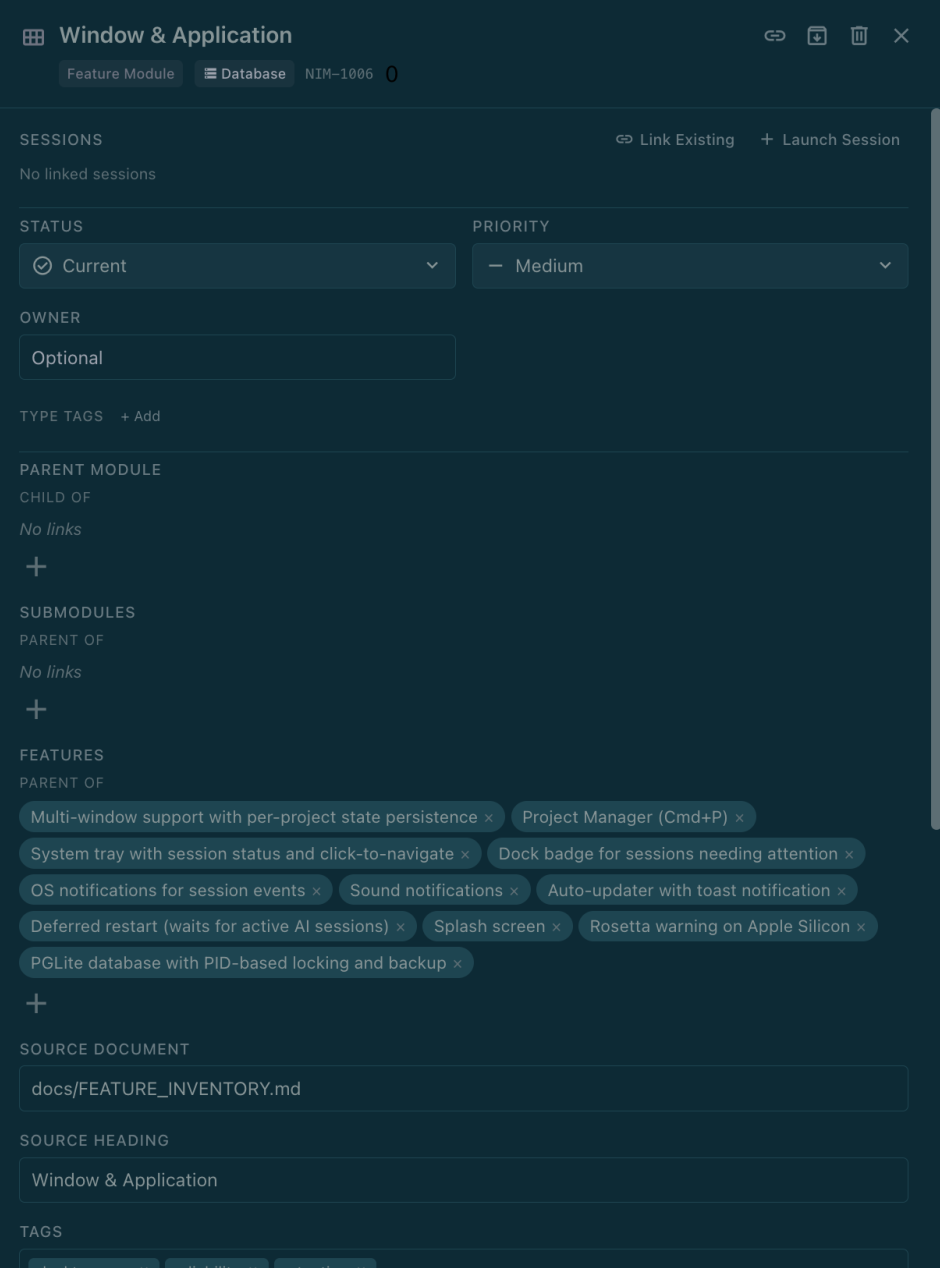
The example below is a custom "Feature Module" type whose schema defines three relationship fields: **Parent Module** (child of), **Submodules** (parent of), and **Features** (parent of, pointing at feature items).
Relationship fields defined on a type: Parent Module (child of), Submodules (parent of), and Features (parent of).
### Set up the fields (ask your agent)
The quickest way to add relationship fields is to ask the AI agent in Nimbalyst to edit the type's schema. For a parent/child hierarchy, tell it something like:
> "For this tracker type, update the schema to support linked trackers. Make this tracker the parent of this tracker, and that one the child (a parent can have multiple children)."
Once it updates the schema, tell it which items to link to which, or let it work the links out from context. You can also edit the schema by hand under **Settings > Project > Trackers** (relationship is one of the field types). See [Custom Tracker Types](/task-management/custom-tracker-types.md).
### Link items
With relationship fields on the type, open an item's detail panel. Each relationship field lists the items already linked as pills. Click the **+** on the field, type in the box to find an item by key or title, and choose it. Remove a link with the **×** on its pill. A field can be restricted to certain target types, so if an item you expect is missing, it may not be an allowed type for that field.
### Two-way "Linked from" backlinks
When a relationship field is paired with an inverse field on the other type, the link stays in sync on both ends. In the Feature Module example, adding an item to **Submodules** automatically fills that item's **Parent Module** field, and removing either side clears the other. A field backlinks only when its schema names an inverse field; a one-way field records just the side you set.
### Relationship types
These are the relationship keys a field can use, with their natural inverse:
| Relationship | Inverse |
| ------------ | -------------------------------------- |
| Parent of | Child of |
| Depends on | Blocks |
| Relates to | Relates to (symmetric) |
| Duplicates | reference (set an inverse to backlink) |
| Supersedes | reference (set an inverse to backlink) |
---
# Agent Instructions
This documentation is published with GitBook. GitBook is the documentation platform designed so that both humans and AI agents can read, navigate, and reason over technical content effectively. Learn more at gitbook.com.
## Querying This Documentation
If you need additional information that is not directly available in this page, you can query the documentation dynamically by asking a question.
Perform an HTTP GET request on the current page URL with the `ask` query parameter, and the optional `goal` query parameter:
```
GET https://docs.nimbalyst.com/task-management/linking-tracker-items.md?ask=&goal=
```
`ask` is the immediate question: it should be specific, self-contained, and written in natural language.
`goal` is optional and describes the broader end goal you are ultimately trying to accomplish on behalf of the user. GitBook uses it to tailor the answer towards what is most useful for that goal.
The response will contain a direct answer to the question and relevant excerpts and sources from the documentation.
Use this mechanism when the answer is not explicitly present in the current page, you need clarification or additional context, or you want to retrieve related documentation sections.